
Lungenkarzinom
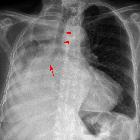


Lung cancer (primary lung cancer), or frequently if somewhat incorrectly known as bronchogenic carcinoma, is a broad term referring to the main histological subtypes of primary lung malignancies that are mainly linked with inhaled carcinogens, with cigarette smoke being a key culprit.
This article will broadly discuss all the histological subtypes as a group, focusing on their common aspects and for further details please refer to the specific articles on each subtype described below.
Epidemiology
Lung cancer is a leading type of cancer, equal in prevalence to breast cancer . It is the leading cause of cancer mortality worldwide; accounting for ~20% of all cancer deaths .
Risk factors
The major risk factor is cigarette smoking which is implicated in 90% of cases and increase the risk of lung cancer, which can be divided by histological subtype :
- squamous cell lung cancer: 11x (men), 15x (women)
- small cell lung cancer: 10x (men), 25x (women)
- large cell lung cancer: 7x (men), 8x (women)
- lung adenocarcinoma: 4x (men and women)
Other risk factors:
- asbestos: 5x increased risk
- occupational exposure: uranium, radon, arsenic, chromium
- diffuse lung fibrosis: 10x increased risk
- chronic obstructive pulmonary disease
Associations
Various paraneoplastic syndromes can arise in the setting of lung cancer:
- endocrine/metabolic
- SIADH causing hyponatremia: small-cell subtype
- ACTH secretion (Cushing syndrome): carcinoid and small-cell subtypes
- carcinoid syndrome
- gynecomastia
- adrenal insufficiency (Addison disease): from bilateral metastases
- hyperparathyroidism: NSCLC can produce parathyroid hormone (extremely rare)
- hypocalcemia: occurs in the setting of skeletal metastases; especially associated with NSCLC
- PTH-related peptide (PTHrp) causing hypercalcemia: squamous cell carcinoma
- neurological
- polyneuropathy
- myelopathy
- limbic encephalitis: particularly associated with SCLC
- cerebellar degeneration
- Lambert-Eaton myasthenia syndrome
- other
- finger clubbing
- hypertrophic pulmonary osteoarthropathy (HPOA): squamous cell carcinoma subtype
- nephrotic syndrome
- polymyositis
- dermatomyositis
- eosinophilia
- acanthosis nigricans
- thrombophlebitis: adenocarcinoma subtype
Clinical presentation
Patients with lung cancer may be asymptomatic in up to 50% of cases. Cough and dyspnea are rather non-specific symptoms that are common amongst those with lung cancer.
Central tumors may result in hemoptysis and peripheral lesions with pleuritic chest pain.
Pneumonia, pleural effusion, wheeze, lymphadenopathy are not uncommon. Other symptoms may be secondary to metastases (bone, contralateral lung, brain, adrenal glands, and liver, in frequency order for NSCLC ) or paraneoplastic syndromes.
Pathology
The term bronchogenic carcinoma is somewhat loosely used to refer to primary malignancies of the lung that are associated with inhaled carcinogens and includes four main histological subtypes. These are broadly divided into non-small cell carcinoma and small cell carcinoma as they differ clinically regarding presentation, treatment, and prognosis:
- non-small cell lung cancer (NSCLC) (80%)
- adenocarcinoma (35%)
- most common cell type overall
- most common in women
- most common cell type in non-smokers but still most patients are smokers
- peripheral
- squamous cell carcinoma (30%)
- strongly associated with smoking
- most common carcinoma to cavitate
- poor prognosis
- large-cell carcinoma (15%)
- peripherally located
- very large, usually >4 cm
- adenocarcinoma (35%)
- small cell carcinoma (20%)
- almost always in smokers
- metastasizes early
- most common primary lung malignancy to cause paraneoplastic syndromes and SVC obstruction
- worst prognosis
Other malignant pulmonary neoplasms include lymphoma and sarcoma (rare).
Each subtype has a different radiographic appearance, demographic, and prognosis:
- squamous-cell carcinoma of the lung
- adenocarcinoma of the lung
- large cell carcinoma of the lung
- small cell carcinoma of the lung
Antibodies and markers
Several antibodies or markers from tissue samples may be useful in the diagnosis and prognostication of disease. These include
- programmed death-ligand 1 (PD-L1)-targeted monoclonal antibodies
- thyroid transcription factor 1 (TTF-1): expressed in most lung cancer except squamous cell cancer
Staging
Treatment and prognosis
Treatment and prognosis vary not only with stage but also with cell type. In general, surgery, chemotherapy, and radiotherapy are offered according to the stage, resectability, operability, and functional status.
Non-small cell carcinoma
- treatment
- operable disease (stage I to IIIA): surgery
- unresectable disease: neoadjuvant chemotherapy, radiotherapy
- advanced disease: palliative combined chemotherapy
- prognosis (5-year survival rates):
- local (stage I): 55-67%
- locally advanced (stages II-IIIA): 23-40%
- advanced (stages IIIB and IV): 1-3%
Small-cell carcinoma
- treatment
- limited disease: chemoradiotherapy
- extensive disease: palliative combined chemotherapy
- prognosis: poor
- limited: 5-year survival rate 15-25%
- extensive: 2-year survival 20% (with palliative combined chemotherapy and supportive care)
See also
Siehe auch:
- Lymphom
- Adenokarzinom der Lunge
- Dermatomyositis
- hypertrophe Osteoarthropathie
- Plattenepithelkarzinom der Lunge
- CT gesteuerte Lungenbiopsie
- Gynäkomastie
- sarkomatoides Karzinom der Lunge
- Plattenepithelkarzinom
- nichtkleinzelliges Lungenkarzinom
- Kleinzelliges Lungenkarzinom
- Karzinoidsyndrom
- Asbest
- Lungenkarzinom Staging
- Metastasen
- large cell carcinoma of the lung
- kleinzelliges Karzinom
- Cushing-Syndrom
- transbronchiale Nadelaspiration (EBUS-TBNA)
- adenocarcinoma
- Nephrotisches Syndrom
- Trommelschlägelfinger
- large-cell carcinoma
und weiter:
- Tumoren der Schädelkalotte
- Kerley-Linien
- Pneumatozele
- Mediastinalshift
- Bronchogene Zyste
- Pancoast tumour
- Phrenikusparese
- Lungenabszess
- kongenitale pulmonale Atemwegsmalformation (CPAM)
- Pierre-Marie-Bamberger-Krankheit
- solitäre lytische Läsion des Schädels
- Kavernöse Lungenläsionen
- more black sign
- solitärer fibröser Tumor der Pleura
- solitärer pulmonaler Rundherd
- Mesotheliom
- In Situ Adenokarzinom der Lunge
- Luftsichelzeichen
- Pleuramesotheliom
- Metastasen in der Orbita
- cancer
- Krukenberg-Tumor
- Milzmetastasen
- pulmonary opacification
- ultrasound appearances of liver metastases
- lobar collapse
- Tumoren der Trachea
- pulmonary cavity (mnemonic)
- bilaterale axilläre Lymphadenopathie
- Rundpneumonie
- Lipidpneumonie
- Syndrom der inadäquaten ADH-Sekretion (SIADH)
- distal appendicular skeletal metastases
- skeletal mass with fluid-fluid levels
- Anthrakose
- large-cell lymphoma of the mediastium
- Obere Einflussstauung
- metastatic axillary lymphadenopathy of unknown primary
- bronchial arterial aneurysm
- intramuskuläre Metastasen
- Lungentumor
- pleomorphic carcinoma of lung
- AIDS defining malignancies
- differential of a large unilateral pleural effusion
- Tumoren des Tracheobronchialsystems
- fibrinous pericarditis
- Thorax Onlinekurs
- reverse S sign of Golden
- radiation-induced lung cancer
- pulmonary neuroendocrine tumours
- Hämoptyse
- neuroendocrine tumours of the lung
- idiopathisches Lungenemphysem mit riesigen Bullae
- gemischt osteolytisch osteoblastische Knochenmetastasen
- dense hilum sign
- differential of an air crescent sign
- Raucherlunge
- smoking related respiratory tract disease
- endobronchial metastases
- inorganic dust
- Bronchozele
- bronchiale Tumoren
- Asbest assoziierte Erkrankungen
- monophasic sarcomatoid carcinoma of lung
- Flüssigkeit-Flüssigkeitsspiegel
- focal pulmonary opacity (mnemonic)
- adenosquamöses Karzinom der Lunge
- eingeblutete Metastasen
- Pankreasmetastasen (Lungenkarzinom)
- Kaverne der Lunge
- pulmonary paragonimiasis
- small round cell lung carcinoma with neuroendocrine features
- hyperdense pulmonale Raumforderungen
- multifocal lung adenocarcinoma
- Ursachen für Perfusionsdefekte in der Lungenventilations / -perfusionsszintigraphie
- cavitating lung cancer
- liver metastases from lung cancer
- metastatic pulmonary nodule from lung carcinoma
- IASLC
- hilar lung cancer
- radionuclide noninvasive determination of lung cancer
- lung carcinoma - on ultrasound
- Metastasen in der Hypophyse


 Assoziationen und Differentialdiagnosen zu Lungenkarzinom:


