Trauma der Speicheldrüsen
Salivary gland trauma is infrequent due to their anatomic position.
Epidemiology
The reported incidence of parotid gland injuries is ∼0.2% of trauma cases. Parotid gland and duct injuries, although rare, is far more common than injuries to submandibular and sublingual glands. This can readily be explained by the anatomic position of submandibular and sublingual glands, which are protected by the mandible .
Clinical presentation
The patient can present with facial swelling, skin laceration and/or skin discolouration (e.g. bruising) at the site of the injured gland.
Pathology
Salivary gland injuries usually occur following penetrating trauma of the parotid or submandibular region and occasionally they are associated with injuries to the adjacent facial and lingual nerves, external carotid artery and retromandibular vein, the ear, and bony structures of the face.
Radiographic features
Ultrasound
The affected gland can have a varied appearance including diffuse enlargement of the salivary gland, heterogeneous internal echogenicity, hyperemia, parenchymal defect or interruption of the execratory duct.
Fluoroscopy
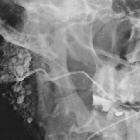
Sialography can be used to assess the patency of the salivary duct.
CT
The salivary gland can appear enlarged and hyperdense, with edema of the overlying subcutaneous fat, an overlying skin defect, laceration of the gland or duct or internal hyperdense hematoma .
Siehe auch:


 Assoziationen und Differentialdiagnosen zu Trauma der Speicheldrüsen: