Nebenhodenzysten

Epididymal
cyst • Epididymal cyst - Ganzer Fall bei Radiopaedia

Epididymal
cyst • Epididymal cyst - Ganzer Fall bei Radiopaedia

Epididymal
cyst • Epididymal head cyst - Ganzer Fall bei Radiopaedia

Teenager with
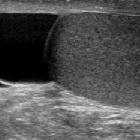
a palpable mass in the right scrotum. Sagittal US (above) and transverse US (below) of the right scrotum shows a round, anechoic, simple lesion in the right epididymis. The right testicle is normal in appearance.The diagnosis was epididymal cyst.
Epididymal cysts are the most common epididymal mass.
Epidemiology
Epididymal cysts have been reported in ~30% (range 20-40%) of asymptomatic individuals .
Pathology
They are usually of lymphatic origin . The cysts contain clear serous fluid, lymphocytes, spermatozoa and debris.
Clinical presentation
Often manifests as a palpable mass. Approximately one-third of patients can be asymptomatic. It may be more prevalent in mountain bikers .
Radiographic features
They can be solitary or multiple with ~30% having more than one cyst .
Ultrasound
- cyst contents in uncomplicated cases are anechoic with no internal echoes
- posterior acoustic enhancement may be seen
- well-defined anechoic lesions
- larger cysts may contain septations
- larger cysts may displace the testis
- this is a differentiating point from hydrocele which envelops the testis
Differential diagnosis
Imaging differential considerations include:
- spermatocele
- usually has some internal echotexture, but may be indistinguishable from an epididymal cyst
- epididymal cysts may arise throughout the epididymis, while spermatoceles almost always arise in the epididymal head
- tunica vaginalis cyst
- paratesticular abscess
- will tend to show surrounding inflammatory changes
- clinical context is different
- small hydrocele to be differentiated from large epididymal cyst with septations
See also
Siehe auch:
und weiter:


 Assoziationen und Differentialdiagnosen zu Nebenhodenzysten: