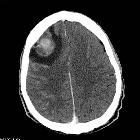
Germ cell tumors
Germ cell tumors are found widely throughout the body and encompass a wide range of individual tumors.
This article does not deal with any specific body locations. For detailed discussion please refer the articles listed at the end of this page.
Pathology
Germ cell tumors arise from ectopic pluripotent stem cells that failed to migrate from yolk endoderm to the gonad. Because they arise from primitive cells, they have variable neoplastic potential and variable degrees of differentiation into a variety of tissues.
Generally, cystic lesions tend to be benign whereas solid lesions tend to be malignant however the final diagnosis is made histologically.
Germ cell tumors are classified by their histology regardless of their location in the body . Although there are many ways of dividing these tumors, a widely used approach is to divide them into seminoma and non-seminomatous tumors.
See: classification of germ cell tumors
- seminoma
- non-seminomatous germ cell tumors (NSGCT)
- embryonal cell carcinoma
- choriocarcinoma
- yolk sac tumor
- teratoma
- mixed germ cell tumor
Additionally a number of other entities not usually included under the heading of germ cell tumor can be included for completeness, as they share many similarities. They include:
- epidermoid cyst: ectoderm only with no epidermal appendages
- dermoid cyst: ectoderm only, but with epidermal appendages
- fetus in fetu / fetiform teratoma
- struma ovarii tumor
Benign (grade 0) tumors have a risk of malignancy despite being indolent initially and require close clinical, serological, and radiological follow-up . There is also a low incidence of malignant transformation of somatic cells (i.e. non germ cell) within these tumors e.g. carcinoma, sarcoma, leukemia .
Siehe auch:
- Teratom des Ovars
- Teratom
- Dermoidzyste
- epidermale Inklusionszyste
- Chorionkarzinom
- Seminom
- mediastinales Teratom
- intrakraniale Teratome
- ovarian dysgerminoma
- Teratom des Hodens
- Foetus in foeto
- intrakranielles Germinom
- mediastinale Keimzelltumoren
- Struma ovarii Tumor
- unreifes Teratom des Ovars
- Dottersacktumor
- reifes zystisches Teratom des Ovars
- classification of germ cell tumours
- nichtseminomatöser Keimzelltumor
- specialised teratomas of the ovary
- ovarian yolk sac tumour
- malignant mixed germ cell tumour of the ovary
- testicular germ cell tumours
- primary intracranial choriocarcinoma
- Dottersacktumor des Ovars
- Dottersacktumor der Glandula pinealis
- intrakranieller Keimzelltumor
- Merkspruch Keimzelltumoren
- Keimzelltumor des Ovars
- intrakranielles embryonales Karzinom
- Chorionkarzinom des Ovars
- reines primäres Chorionkarzinom des Ovars
- staging of germ cell tumors
und weiter:
- Tumoren der Hypophysenregion
- Pinealiszyste
- Tumoren des vorderen oberen Mediastinums
- Pituitary MRI (an approach)
- Tumoren der Pinealisregion
- Germinom
- Pineoblastom
- Pineozytom
- Hodentumoren
- anterosuperior mediastinal mass (mnemonic)
- maligne Neoplasien des Hodens
- Raumforderungen oberes Mediastinum
- suprasellar / hypothalamic lesions
- dysgerminoma
- testicular mixed germ cell tumours
- teratoma suprasellar
- testicular yolk sac tumour
- Epidermoidzyste der Glandula pinealis
- fetales perikardiales Teratom
- Dottersacktumor des Hodens
- Keimzelltumor des Retroperitoneums
- Embryonales Karzinom
- Keimzelltumor lymphogene Metastasierung
- maligner Keimzelltumor


 Assoziationen und Differentialdiagnosen zu Keimzelltumor: