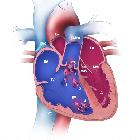
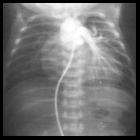
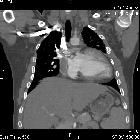
congenital cardiovascular anomaly


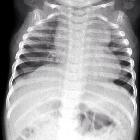


Congenital cardiovascular anomalies are relatively common, with an incidence of up to 1% if small muscular VSDs are included. As a group, there is a much greater frequency in syndromic infants and in those that are stillborn.
Clinical presentation
Broadly, congenital cardiovascular anomalies can be clinically divided into:
Depending on the lesion and its severity, patients may be asymptomatic or conversely, may present with rapidly deteriorating congestive cardiac failure.
Pathology
These defects as a group have a heterogeneous etiology with many resulting from an interplay between both genetic and environmental factors.
Subtypes
A list of anomalies and their approximate occurrences (as a percentage of all congenital cardiac disease) are given below:
- ventricular septal defect (VSD): 40%
- atrial septal defect (ASD): 10%
- congenital pulmonary stenosis: 8%
- patent ductus arteriosus (PDA): 7%
- transposition of the great arteries (TGA): 7%
- tetralogy of Fallot (TOF): 5%
- coarctation of the aorta: 5%
- atrioventricular septal defect (AVSD): 4%
- congenital aortic stenosis: 4%
- hypoplastic left heart syndrome (HLHS): 4%
- double outlet right ventricle (DORV): 2%
- interrupted aortic arch (IAA): 1.5%
- truncus arteriosus: 1%
- total anomalous pulmonary venous return (TAPVR): 1%
- tricuspid atresia: 1%
- pulmonary atresia:
- Ebstein anomaly: 0.7%
- Bland-White-Garland syndrome: ~0.5%
- cor triatriatum: ~0.1%
- partial anomalous pulmonary venous return (PAPVR): 0.5%
- double outlet left ventricle (DOLV)
- aortopulmonary septal defect: <1%
- Gerbode defect: <1%
- Shone complex: <1%
- hypoplastic right heart syndrome (HRHS)
- aortoventricular tunnel <0.1%
Other valvular anomalies
Percentages may not necessarily add up to 100 due to overlap and simultaneous occurrence of abnormalities.
Associations
Congenital cardiac anomalies can be found with many aneuploid conditions which include:
- trisomy 18: up to 90% can have cardiac anomalies
- trisomy 13: up to 90%
- trisomy 21: up to 50%
- Turner syndrome: up to 40%
Siehe auch:
- Aortenisthmusstenose
- Persistierender Ductus arteriosus
- Normvarianten Koronararterien
- Chiari-Netz
- Atriumseptumdefekt
- Pätau-Syndrom
- Down-Syndrom
- Cor triatriatum
- Fallot'sche Tetralogie
- Turner-Syndrom
- Ebstein anomaly
- Trisomie 18
- Varianten der Herzanatomie
- Transposition der großen Arterien
- Bland-White-Garland-Syndrom
- tricuspid atresia
- Normale Herzkonfiguration im Röntgen-Thorax
- hypoplastic left heart syndrome
- double outlet right ventricle (DORV)
- quadricuspid aortic valve
- Bikuspidalität der Aortenklappe
- totale Lungenvenenfehlmündung
- partielle Lungenvenenfehlmündung
- atrioventricular septal defect (AVSD)
- Divertikel des linken Vorhofs
- conotruncal cardiac anomalies
- Ventrikelseptumdefekt
- Pulmonalatresie
- congenital aortic stenosis
- Single Ventricle
- fibromuskuläres Band im linken Vorhof
- Valvula Eustachii
- kongenitale Pulmonalstenose
- Atresie der Aorta
- Truncus arteriosus communis
- congenital heart disease : CXR approach
und weiter:
- Lungensequester
- Ektasie Aorta ascendens
- acute respiratory distress syndrome (ARDS)
- kongenitale pulmonale Atemwegsmalformation (CPAM)
- einseitig vermehrte Transparenz Thorax
- Hydrops fetalis
- Ösophagusatresie
- Situs inversus
- Chylothorax
- Situs ambiguus
- nuchal translucency
- acyanotic congenital heart disease
- Mikrognathie
- rechts descendierende Aorta
- Diastrophische Dysplasie
- mandibuläre Retrognathie
- fetal pleural effusion
- nuchal thickness
- epikardiale Schrittmachersonden
- abnormal ductus venosus waveforms
- fetal conditions associated with maternal diabetes
- CHARGE-Syndrom
- Golfballphänomen
- caudal dysplasia sequence
- Ellis-van-Creveld-Syndrom
- Abernethy malformation
- CXR approach to congenital heart disease
- Fetales Valproat-Syndrom
- Embryopathia rubeolosa
- Rubinstein-Taybi-Syndrom
- Cornelia-de-Lange-Syndrom
- camptomelic dysplasia
- Surfactant-Mangelsyndrom
- Goldenhar-Gorlin-Syndrom
- absent ductus venosus
- Fryns-Syndrom
- Polysplenie-Syndrom
- Lungensequester extralobulär
- chest x-ray appeoach to congenital heart disease
- congenital heart disease - chest x-ray approach
- Thrombozytopenie-Radiusaplasie-Syndrom
- verzögerte Skelettreifung
- mesoectodermal dysplasia
- fetal tachyarrhythmia
- transient tachypnea of newborn
- anomalous left coronary artery off the pulmonary artery
- fetal complete atrioventricular block
- Zyanotischer Herzfehler
- dilantin embryopathy
- hydrolethalus
- fetal bradyarrhythmia
- McKusick-Kaufman-Syndrom
- Miller-Dieker Syndrom
- lentiginosis profusa syndrome
- iron deficiency anaemia
- four chamber cardiac view
- Zephalozele
- congenital vascular anomalies
- fetal nuchal oedema
- Herzektopie
- camptomelic dwarfism
- retained foetal fluid
- cyanotic congenital cardiac anomaly
- kongenitaler Hydrozephalus
- Nabelvenenaneurysma


 Assoziationen und Differentialdiagnosen zu congenital cardiovascular anomaly: